Cybersecurity has moved from the IT department to the boardroom—and to every employee’s inbox. From preventing ransomware attacks to ensuring regulatory compliance, organizations need skilled professionals who can act quickly and effectively. But not every role demands the same knowledge, and not every learner starts from the same place.
That’s cybersecurity certifications matter—and why choosing the right certification matters even more.
CyberUP Institute offers a structured pathway into cybersecurity, tailored to each professional profile. This guide breaks down the options, so you can find the course that aligns with your experience, goals, and responsibilities.
Why Choose a Certification?
Cybersecurity today isn’t just about keeping up—it’s about staying ahead. As threats become more sophisticated and regulations more demanding, the ability to demonstrate proven, up-to-date skills has become essential. Cybersecurity certifications offer a structured way to build that expertise while validating your readiness for real-world challenges.
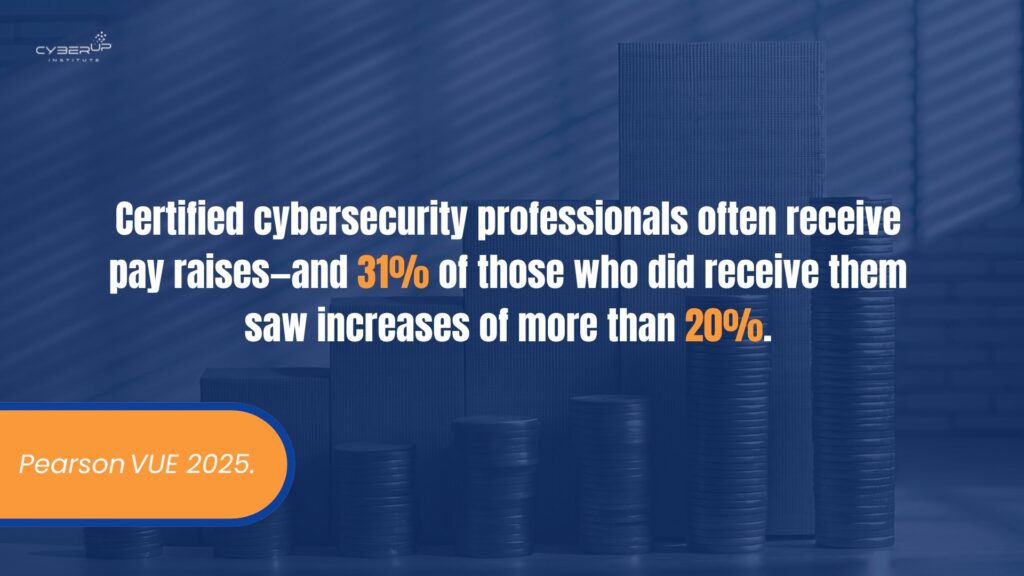
Getting certified means more than passing a test. It signals that you’ve mastered essential concepts, practiced in realistic environments, and understand how to apply your knowledge in context. For employers, that builds trust. For you, it means stronger job prospects, increased credibility, and a clearer path for career development.
Certifications also provide structure in a fragmented field. They help you:
- Understand what employers expect at different career stages.
- Identify the tools and practices used in real-world environments.
- Align your skills with industry frameworks like NIST, ISO 27001, or MITRE ATT&CK.
At CyberUP, certification means applied knowledge. Each course is grounded in real scenarios, adapted to specific roles, and designed to build capability, not just familiarity. Whether you’re entering the field or sharpening your expertise, a CyberUP certification shows that you’re prepared—not just on paper, but in practice.
Which Cybersecurity Path Is Right for You?
Choosing a cybersecurity course can feel overwhelming when there are so many titles, tools, and certifications out there. But CyberUP doesn’t believe in one-size-fits-all training. Instead, it organizes its programs into clearly defined paths—each designed to meet the real needs of a specific audience, from public institutions and SMEs to IT professionals and executives. Here’s how to find the path that aligns with your background, goals, and the kind of impact you want to make.
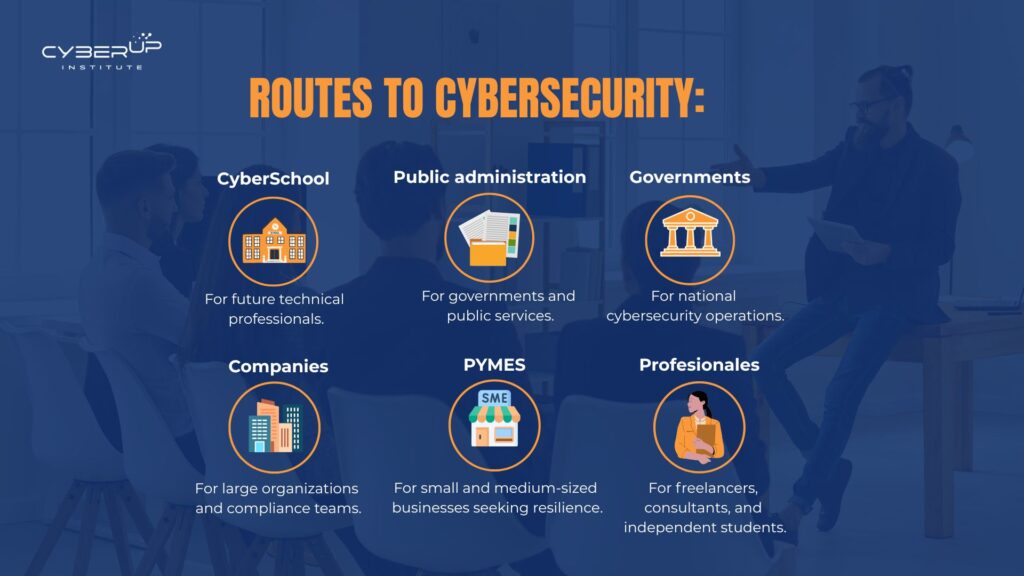
1. CyberSchool: Build Your Technical Foundations
If you’re new to cybersecurity or transitioning from IT into a more specialized role, CyberSchool is where you begin. It’s designed to help aspiring professionals go from understanding basic systems and networks to operating confidently in live cyber environments. Rather than jumping straight into abstract theory, CyberSchool focuses on hands-on, progressive learning through technical challenges that simulate real-world scenarios.
The learning path is structured around the core technical areas needed to enter the job market:
- Cyber Ops Associate introduces foundational concepts in security operations and system defense.
- Cybersecurity Technician OS focuses on securing operating systems and endpoint devices.
- Cybersecurity Technician Networking teaches how to monitor, configure, and defend networks.
- Cybersecurity NetOps brings it all together, preparing students for operational roles in active network environments.
This track is ideal if you’re planning to apply for your first role in a SOC (Security Operations Center), looking to retrain from another IT discipline, or simply want to understand the infrastructure behind cyber defense.
2. Public Administration: Secure Essential Services
Public sector institutions face a unique dilemma: they must digitize essential services while maintaining high levels of transparency, accessibility, and trust. At the same time, they’re often under-resourced compared to private sector counterparts, making them attractive targets for cybercriminals.
CyberUP’s Public Administration path helps ministries and public agencies enhance digital resilience without disrupting service delivery. It includes both general awareness and advanced training to address risks like data leaks, DDoS attacks, and system hijacking in essential infrastructures such as health, energy, or transportation.
Key focus areas include:
- Incident Response and SOC training to help public IT teams coordinate under pressure.
- Red vs. Blue Team simulations that recreate attack-defense scenarios.
- Network Forensics and QRadar training for real-time threat monitoring.
- Role-based awareness modules for staff, technicians, and management.
This is the right choice if you work in a public IT department, lead digital transformation in a ministry, or are responsible for critical service continuity.
3. Governments: Strengthen National Cyber Defense
Some institutions don’t just manage services—they safeguard sovereignty. For these actors, cybersecurity must reach a higher level of readiness. The Governments path is built for national entities with strategic cyber defense responsibilities: CERT teams, defense ministries, national security bodies, and operators of essential infrastructure.
Unlike basic training, this track focuses on complex, persistent threats—the kind that require surgical analysis, long-term strategy, and coordinated response.
It includes:
- Advanced Forensic Fileless techniques for detecting evasive, non-traditional threats.
- Reverse Analysis of malware and APT payloads.
- CTF Offensive training to simulate adversarial logic.
- Red vs. Blue Team exercises to strengthen both attack and defense.
CyberUP designed this track to help governments anticipate threats, build internal capabilities, and reduce dependency on external vendors. It’s not about reacting—it’s about preparing for tomorrow’s attacks today.
4. Corporate: Manage Risk at Scale
Large companies often operate across multiple digital environments — cloud platforms, internal systems, third-party vendors, and globally distributed teams. Managing security across that complexity requires more than a firewall: it demands coordinated, role-based training aligned with both compliance and operational goals.
CyberUP’s Corporate path is built to meet this challenge. It offers a modular training structure that can be tailored to each department’s responsibilities — technical, legal, or operational. Every course combines real-world relevance with practical implementation, ensuring that cybersecurity becomes an embedded part of your company’s day-to-day practices.
Key components include:
- Cyber Awareness modules for staff, tech teams, and managers.
- Secure Code Development to reduce vulnerabilities during software design.
- Incident Response and QRadar training for internal IT and SOC teams.
- GDPR and regulatory-focused sessions for compliance officers.
This track is especially relevant for organizations preparing for ISO 27001, DORA, or NIS2, or simply aiming to raise internal cyber maturity. It’s also ideal for companies managing digital transformation at scale.
5. Micro and SMEs: Keep Your Business Resilient
Small and medium-sized businesses are often caught in a dangerous middle ground: big enough to be targeted, small enough to lack in-house security experts. CyberUP’s SME path was built to address this challenge with agile, easy-to-implement courses.
Rather than overwhelming small teams with overly technical material, this path focuses on empowering key personnel with the knowledge to prevent, detect, and respond to the most common threats. It also equips decision-makers with the tools to integrate cybersecurity into business planning.
Courses like Cyber Crisis Management teach:
- What to do when a breach occurs.
- How to communicate and mitigate reputational damage.
- How to integrate security into budgets and business continuity plans.
If you’re running a growing business or managing IT for an SME, this path is your launchpad.
6. Professionals: Learn Independently, Certify Strategically
Not every cybersecurity learner is part of a team. Some are building their own path—whether switching careers, freelancing, or simply building skills on their own terms, CyberUP’s Professionals path offers self-contained, high-impact training.
The Cyber Security for Professional program gives you:
- A complete introduction to system, network, and threat fundamentals.
- Interactive labs and live simulations.
- A certification that shows employers or clients your capabilities.
This is ideal if you’re preparing for a cybersecurity job application, pursuing additional credentials, or offering cyber services as a consultant. It lets you train at your own pace—while working toward a cybersecurity certification that demonstrates both knowledge and practical competence.
What Makes CyberUP Certifications Different?
With so many cybersecurity courses available today, it can be difficult to tell which ones offer real value and which are just surface-level. CyberUP stands out by designing every program around practical impact, not just theoretical knowledge. The goal isn’t to simply teach concepts—it’s to prepare individuals and teams to respond effectively in real-world scenarios.
Unlike static video modules or generic online content, CyberUP’s training is:
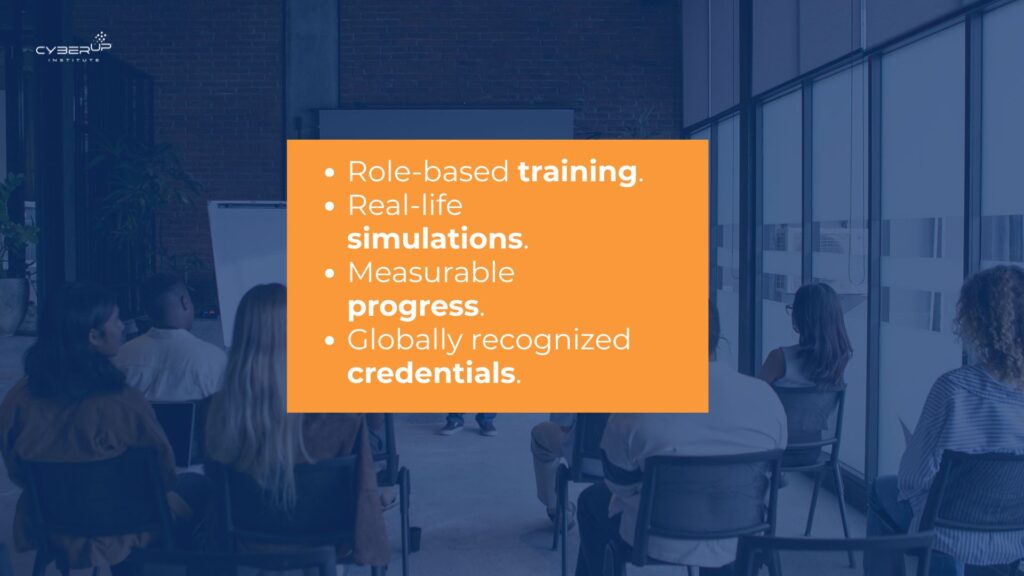
- Simulation-based: Learners train in environments that mimic real cyberattacks, making the skills they acquire immediately applicable.
- Role-specific: Programs are segmented by professional profile—technical staff, managers, executives—ensuring that everyone learns what’s relevant to their function.
- Measurable: Progress is tracked through challenges, performance metrics, and practical exercises, so both individuals and organizations can assess results.
- Globally recognized: Every course concludes with a certificate backed by institutional partners and trusted across sectors.
Whether you’re securing a small business or leading a national cyber strategy, CyberUP gives you more than just a certification—it equips you to take action.
Start Your Path to Certification
Cybersecurity is no longer a specialized niche—it’s a shared responsibility across industries, sectors, and roles. Whether you’re leading digital strategy for a government agency, managing risk for a multinational company, or just stepping into the field, there’s a CyberUP path designed to meet you where you are.
Each course delivers more than content—it builds capability. With hands-on simulations, expert-designed curricula, and role-based flexibility, CyberUP certifications help individuals grow, teams align, and organizations become truly resilient.
Ready to take the next step? Explore all training paths and find the course that fits your goals.